
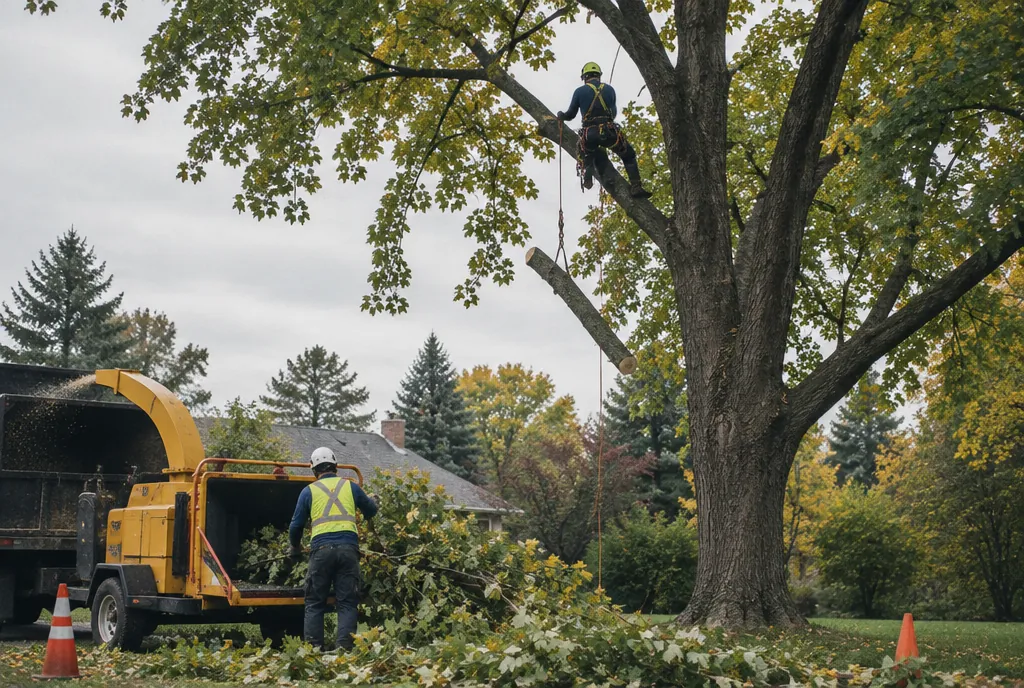
Why tree owners quote the job, not the hour
Almost every owner we studied builds the price from an hourly rate and then gives the customer one number for the tree. Billing tree work by the hour punishes a fast crew for being quick, and on a slow day the customer starts to think you were dragging it out.
The hourly rate still does the work behind the scenes. Find an hourly rate that pays for your crew, your trucks and your overhead, then apply it to the hours each tree will take. That is the method owners describe as the most reliable, and it is the one the spreadsheet follows.
Your rate has two parts: people and overhead per labour hour, and each truck or machine per hour it runs. The sample shop needs $65.13 per labour hour before equipment. How to build both numbers, and how to go from man-hours to crew-hours, is on tree service cost per hour.
What makes one 70 ft tree cost more than another?
Height is the smallest part of a tree price; what's under it sets the hours. The more obstacles there are, the more rigging you do and the farther the brush gets dragged, and the higher the price has to be.
- The drop zone. Limbs over a roof get rigged down one at a time; the same maple in an open field gets felled. Knocking a house power drop off its post can mean anywhere from a hundred to a few thousand dollars of repairs.
- Access. Ask whether a truck, a trailer, a chipper and a skid steer can each get back there, and whether there are fences or gates in the way. Every no is more carrying by hand.
- Chip or leave. Whether you must chip on site or can leave the brush and wood makes a big difference to the hours. Owners price lower when the customer takes care of disposal.
- What's in the tree. Old tree forts, ladders, signs and feeders leave nails and hardware behind, which ruin chains and limit what the wood is worth.
- What's under the ground. One owner bid $1,100 for two broken-top trees mostly because they stood over the septic area and leach field, not because they were big.
Worked example: a silver maple over the house and a spruce by the shed
The sample job removes a 70 ft silver maple leaning over the house (limbs rigged off the roof, house power drop kept up), removes a 30 ft spruce by the shed, chips all brush, hauls all wood, grinds 2 stumps and rakes out. A crew of four spends about 7 hours on site, with the bucket truck on the maple and the chip truck there all day.
Each piece of the job (rigging, felling, chipping, grinding, clean-up) gets a crew size, hours and the machine it needs, which also becomes the scope on the customer's copy. Once the hidden hours are counted the job carries 38.5 labour hours.
| A | B | |
|---|---|---|
| 1 | Part of the price | Sample removal |
| 2 | Supplies, crew labour and equipment | $2,390.44 |
| 3 | Dump fees and hidden costs | $866.27 |
| 4 | Markups, safety cushion and profit | $1,091.45 |
| 5 | Price | $4,348 |
The $1,091 above cost is about 25% of the price, left after the owner has been paid a wage. Spread over all 38.5 hours, the crew earns about $93 a labour hour against the $65.13 break-even. On a $3,256.71 cost that is a 33.5% markup; the markup vs margin guide shows why the two numbers differ.
Tree removal prices owners gave on real jobs
These are single owners' prices on real jobs, not averages. They show how far apart fair prices can sit, depending on crew, equipment and market.
| A | B | C | |
|---|---|---|---|
| 1 | Job | Price | Where |
| 2 | 7-hour, two-tree day, padded to 9 hours for delays | $2,025 | A three-person crew in Northeast Ohio |
| 3 | 4-hour tree plus $200 disposal minimum | $2,500 | A crew pricing per crew-hour |
| 4 | 100+ ft co-dominant Douglas fir by the house and drop | $4,800 | An Oregon owner |
| 5 | 16 trees, no disposal, two people for a day | $2,200 | A Minnesota owner |
| 6 | Two broken-top trees over the septic area, one-man crew | $1,100 | A one-man side business |
The Oregon owner expected a cheaper company to win the $4,800 fir, and priced it anyway, because that was what the tree cost him to do safely. The sample job's $4,348 for 7 hours sits close to the crew-hour pricer's rate plus disposal, and well above the Ohio crew's numbers, which its owner calls a little low for his own area.
Drive time, the dump line and 6 more costs that never touch the tree
Tree jobs leak money in the hours before the first cut and after the last chip. On the sample job the hidden-cost list adds $746 of cost; leave it out and the same profit rules price the job about $979 lower.
Count the crew's time from the moment they get out of their own cars and into company trucks to the moment their feet are on the ground at the job. Then do the same on the way back.
- Drive time for every person on the crew, both waysCounted from the shop, times four people.
- Dump runs and the line at the dumpPrice the ride and the time it takes to tip. A 100 ft fir can mean two or three chip truck loads, so count the loads before you price it.
- The morning load-upFueling saws, hooking the chipper, the coffee talk. There is always some, so keep it short and keep it on the quote.
- The estimate tripBig jobs can take a day or two of looking and thinking before a number goes out, and you look at more trees than you win.
- Calling 811 and finding septic lids, sprinkler heads and private linesCheck for all of them before the stump grinder goes in.
- DelaysA machine that quits mid-job, a crew member going down in summer heat, a flat tire, a homeowner who wants to chat. One owner pads a 7-hour job to 9 for exactly this.
- Keeping saws and chipper knives cuttingFiles, bar oil and new knives are small per job and real over a season.
- Money set aside for damageTo the house drop, a fence or a septic lid, on every job near a house.
A crane is the big outside cost: one Ohio owner pays about $1,200 a day for a 38-ton crane, and it should carry a markup for booking and coordinating it. Comparing each job's real hours to the bid with job costing shows which of these lines your crew underestimates.
How much to charge for small trees, limbs and stumps
Small jobs are priced from the minimum up, not from the tree down. A 15 ft ornamental still needs the truck, the chipper, the drive and a dump run, which is why some owners do nothing below a day rate and others charge a $200 disposal minimum whenever the chipper comes off the truck.
Limb removal and trimming use the same crew rate with the hours shifted: more climbing, less felling and hauling. Stump grinding is grinder hours, operator time and tooth wear; as an add-on to a removal it rides on a drive you've already paid for, and as a stand-alone call it carries its own trip.
Some callers are shopping for the cheapest possible removal. It is fine to lose those calls. A price that covers the truck and the drive is worth more than a day spent on a job that paid nothing.
Per-foot tree pricing: $25 a foot or $43 a foot?
A per-foot price is a quick check on your hours, not the quote. One owner starts hazardous removals at $250 per 10 feet, about $25 a foot, then adds for the house, the lines and the drop zone. The sample job's 100 feet of tree works out to about $43 a foot including chipping, hauling and 2 stumps.
The gap is the house. A 70 ft maple over a roof and a 70 ft maple in a pasture are different jobs, which is why owners who start from a per-foot rate still walk the tree and time it.
Mistakes new climbers make when quoting trees
The most common one is naming a price in the driveway. Quoting on the spot, without much thought, is how a lot of new owners end up too low. Take photos, go home, and price the tree piece by piece.
The second is the tree that feels like a $2,000 job and then eats 10 or 12 hours once you find a leach bed under it and have to rope everything down. That tree should have been bid at $2,500 or three thousand, and the only way to see it coming is to walk the ground as well as look up.
The last mistake is a loose scope. Get the job in writing and be specific about everything you will do, so a customer's while-you're-here limb becomes a written change order with its own price. Spelling out whether the wood stays or goes does the same for disposal, and quote vs estimate covers when a tree price should be firm.
Quote the next removal in the spreadsheet
The Tree Service Pricing Calculator turns your crew, trucks and overhead into hourly costs, builds each tree from its pieces, and asks every hidden-cost line above before it gives you a price. Start with your own rate in the free true hourly rate calculator if you want to see the method first.