
Why coaters price by the minute and the rack, not the square foot
Most working coaters time each step and price the part, because hanging, plugging and colour swaps cost the same on a small bracket as on a big gate.
A good quoting sheet walks through degrease, blast, outgas, spray, cure and wrap one by one. On a single small part, one owner allows about five minutes of blasting, ten to twenty minutes of outgassing and at least 25 minutes in the oven. He bills labour at $85 an hour, or $1.42 a minute, and oven time at $0.42 a minute.
That oven figure is what he wants the oven to earn with parts inside, not what the gas costs. The part that matters most is that one cure covers a whole rack. Twenty-five minutes of oven time on one part is 25 minutes of cost on that part; the same 25 minutes shared by 40 parts is under a minute each. The more parts hang on the rack, the cheaper each one gets to cure.
100 steel brackets at $20.43 each: the worked quote
The example order prices at $2,042.91 for 100 brackets, keeps $555.84 above every cost, and earns about $82 per labour hour.
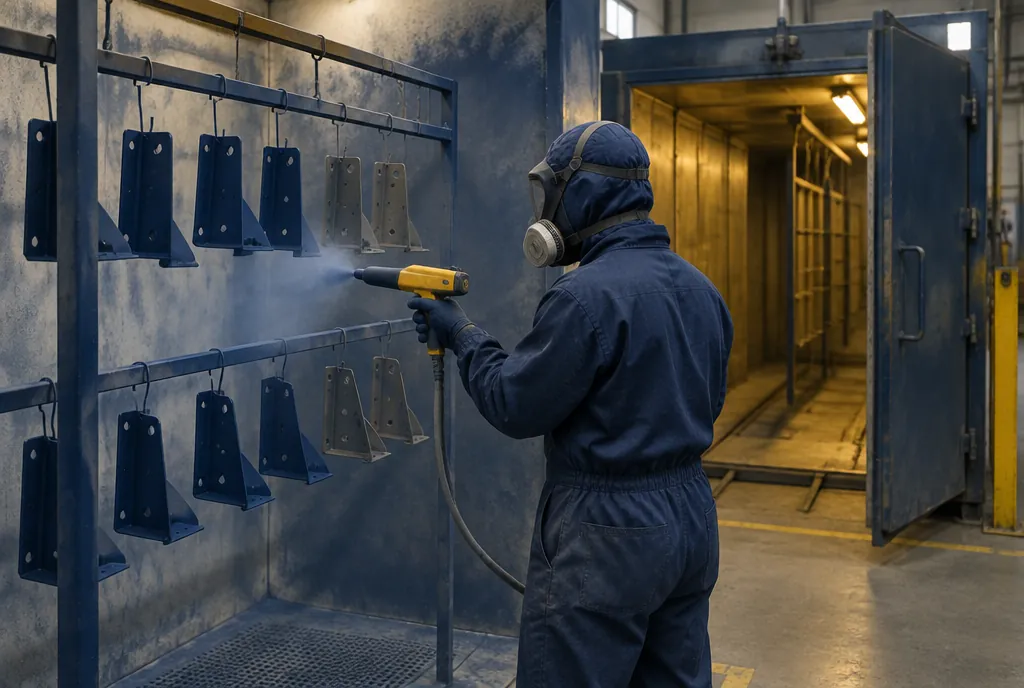
The parts are steel mounting brackets about 12 by 6 inches, one colour, with two holes masked on each. They go through the wash, the blast cabinet, the booth and a batch oven, then get wrapped and shipped back on a pallet.
| A | B | |
|---|---|---|
| 1 | The order of 100 | Amount |
| 2 | Powder and prep supplies, marked up | $306.50 |
| 3 | Labour and equipment time | $699.84 |
| 4 | Freight and the don't-forget lines | $480.74 |
| 5 | Price for 100 | $2,042.91 |
The last $555.83 of that is markups, cushion and profit. It is 27.2% of the price, and it is left after the owner has already been paid a wage. The work takes about 19 labour hours, so the job earns roughly $82 an hour against the shop's $51 break-even, close to the $85 an hour that one working shop bills.
Why 25 brackets cost $32.88 each and 500 cost $17.11
The price per bracket falls as the order grows because oven heat-up, the colour change, rack stripping and freight happen once per job, whatever the count.
At 25 pieces the same quote comes to $32.88 a bracket. At 500 it drops to $17.11. Business-to-business pricing from one coating shop slopes the same way: 100 parts at $20 each, 500 a month at $15 and 10,000 a year at $10.
Show two or three quantities on the quote and let the customer pick. A buyer who sees the price drop at 500 will often order more, and the bigger run is usually the better job for the shop too, because the booth stays in one colour and the oven runs full.
The $85 labour rate and the $51 break-even behind it
Our example shop, an owner and two crew, needs $51 per billable hour to cover wages and $53,800 a year of overhead before equipment or profit.
About three quarters of that is people cost, and the rest is rent, gas and power for the oven and compressor, insurance and the smaller bills. Equipment goes on top per running hour, so a step in the oven costs more than a step at the bench. The break-even method is in the true hourly rate guide, and you can run your own in the free true hourly rate calculator.
Powder gets its own markup. In one owner's worked example, powder costs $5 a pound and he multiplies it by 1.25 before it goes on the quote, because selling powder at what you paid for it means working for free on the part of the job you had to buy first. That 25% pays for ordering, storing, overspray on the booth floor and the half box that goes stale on the shelf.
The 27.2% the bracket order keeps is a margin on the price, a different number from a markup on cost. A 25% markup on $100 of cost gives a $125 price and a 20% margin, not 25%. Markup vs margin shows the gap.
Wheels, tumblers, bracelets and B2B parts: what coaters charge
Coaters in the videos we studied charge by the piece, the set or the batch, from $2 bracelets to $1,500 wheel sets.
| A | B | |
|---|---|---|
| 1 | Example | What they charge |
| 2 | One shop's quoting sheet | $85/hr labour, $0.42/min oven; one small part priced at $50.08 |
| 3 | The same shop's retail work | Wheels $400 to $1,500 a set; tumblers $20 to $60; signs $50 to over $1,000 |
| 4 | The same shop's business parts | 100 parts at $20, 500 a month at $15, 10,000 a year at $10 |
| 5 | A small blasting and coating shop | Bracelets at $2 each, 50-piece minimum, customer buys the powder |
These are single shops, not averages. The first shop's example $600 wheel set takes about 4 hours and $50 of materials, which works out to $137.50 an hour before anyone is paid, rent and gas included. The same owner puts production margins at maybe 30% after labour, materials and overhead, slimmer than custom work, which is why production pricing has to be built from real minutes rather than a round number.
The bracelet quote was built on roughly $20 an hour, which is why the minimum mattered more than the piece price. None of these shops quoted by the square foot. Our brackets work out near $20 a square foot at 100 pieces, but a flat sheet of the same area needs far less hanging and plugging, so use per-foot only to compare similar parts.
Colour swaps, plugged holes and a cold oven: the minutes coaters leave off
In the example these small lines add $335.74 to the cost of the order; leave them all out and the same rules price the brackets at about $16 each instead of $20.43.
Colour changes. Emptying the hopper, cleaning the gun and blowing down the booth happens between jobs, so it never feels like part of one. Some small shops charge a flat few dollars for every change after the opening colour; timing it at your own shop rate is safer, since a thorough change can take a quarter hour.
Plugs in threaded holes. Powder left in a threaded insert makes the part hard to assemble, and the customer finds out at install. A few seconds a hole, times every hole, times every part, can cost more than the powder on a big order.
The oven heating up for the first rack. Gas and a person waiting cost the same for one part as for a full load. That is why one-off parts are so expensive, and why a minimum charge exists.
Old powder on hooks and racks. Cured powder built up on hooks stops parts grounding properly, so the powder doesn't stick evenly. Stripping them is caused by the jobs that ran on them, so it belongs on the quote.
Outgassing castings and greasy parts. Cast metal and oily parts are the ones that bubble. Outgassing takes ten to twenty minutes in the oven, a full extra cycle that often gets lumped into cure time and never charged.
The test piece, rework, wrap and paperwork. A colour sample before the run, a small allowance for parts that go back through, stretch wrap and foam, and the calls and invoices around the job all take real time. Wrap time belongs on every part.
Two more ride in overhead rather than on the quote: PPE (gloves, spray hoods and respirators) and longer cure time on heavy parts, since the cure timer starts when the part reaches temperature, not when the oven does.
Where a $30 counter guess goes wrong
Most powder coating losses start with a price said out loud before anyone timed the job.
Guessing at the counter. One owner who ran a walk-in part through his sheet got $50.08, where his counter guess would have been about $30, a gap of 40% on one piece. He also admits the customer probably would not pay $50, so one-offs only pay when they ride on a rack already running that colour.
Taking single pieces. A small shop asked to coat bracelets one at a time set a 50-piece floor at $2 each instead, because a lone piece does not cover the booth and oven.
Customer-supplied powder with no extra. When the customer buys the powder, ask for it before you start, with extra for gun and hopper loss, and still charge full labour and oven time.
Skipping the card fee. Tell customers up front there is a 3% fee on card payments. On a job keeping 27%, a 3% cut is a ninth of the profit.
After the job, compare the hours you quoted with the hours the rack really took; job costing explains the habit.
One colour, no bent wheels: what to write on a powder coating quote
Written terms turn most of the surprises above into extras you can bill.
- The price covers one colour. Each extra colour change is its own line.
- Hidden problems are extra. Rust, filler or old coating found during blasting gets priced before you carry on. Sanding out curb rash on a wheel is coating prep; straightening a bent wheel is not, so say you don't do it.
- Masking only where the customer marks it. Threads, bearing fits and machined faces.
- Castings may bubble. Say that you outgas them and what happens if they still do.
- Colour matches the powder maker's sample, not a phone screen.
Anything the customer adds after saying yes goes on a written change order. For the difference between a fixed quote and a rough estimate on unknown parts, see quote vs estimate, and for where the $53,800 of overhead fits, see overhead and profit. The Powder Coating Pricing Calculator comes with ready-made terms along these lines that you can edit.