
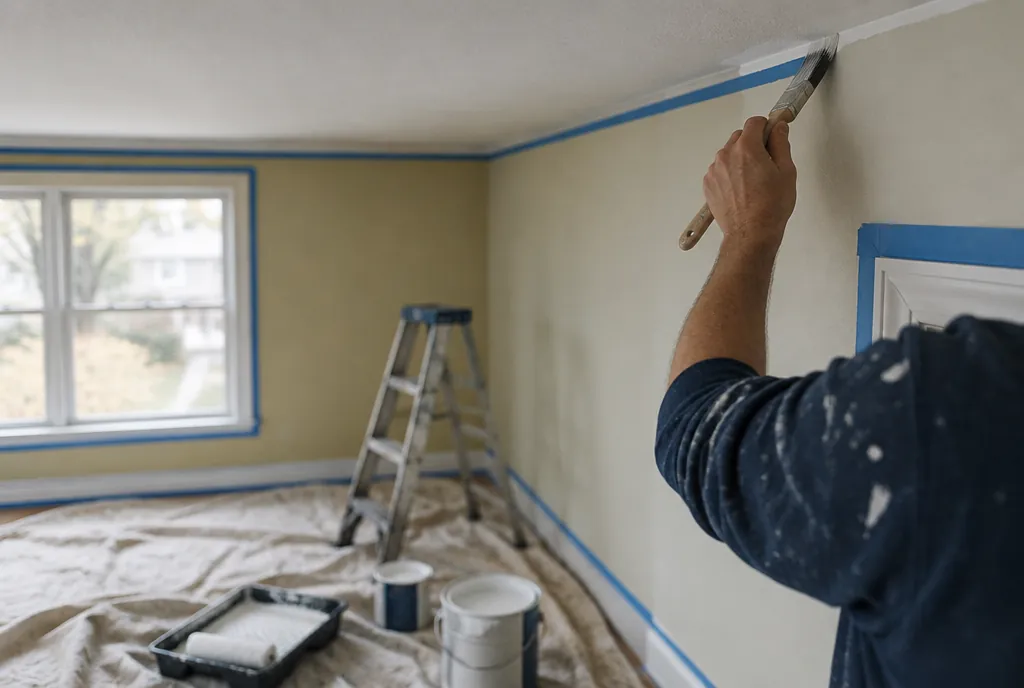
Why painters build from hours and gallons, not floor square feet
Painters sell two things, labour and paint, so the price is built from crew hours and gallons and only checked per square foot. Pricing by the floor makes little sense when the floor is the one surface you don't paint, yet owners still quote flat rates like $2.50 or $3.50 a floor foot. Two houses with the same floor area can have very different walls, ceilings, trim and windows.
Better units are wall area and gallons. In one coach's example a painter covers about 150 sq ft of wall per labour hour, and a gallon covers about 300 sq ft of wall or 900 linear feet of 4-inch trim. Another painter works from the 300 to 400 sq ft per gallon per coat printed on the can, knowing real coverage runs lower on rough or thirsty walls. Your own crew's speed is the one that counts, and the Job Log is where you find it.
Keep labour and paint as two numbers, too. Blend them into one figure, whether per foot or a day rate with paint included, and you can't tell which one you got wrong when a job loses money.
Day rates, room prices and gallons painters use
These are single owners' and coaches' numbers, not averages:
| A | B | C | |
|---|---|---|---|
| 1 | Who | What they charge | How |
| 2 | One owner, interior repaint | $7,914 for a 4 bed / 4 bath, 2,300 sq ft house | $894.40 a day for two painters x 6 days, plus about 30 gallons doubled |
| 3 | A painting coach | $72 an hour; 100 hours and 10 gallons = $8,000 | Average two wages, add 20% burden, double it |
| 4 | An owner who priced by the room | $600 for a standard 12x12 bedroom; +$150 closet, +$50 door | Flat room prices, used for years as the company grew |
| 5 | A painter pricing one playroom | $483 for the walls; $879 with ceiling and baseboards | Labour and paint set at 60% of the price |
| 6 | A coach who bills repairs | $45 to $70 an hour | Time and material on exterior repairs |
The playroom (10 ft high, 11.4 x 15 ft) also shows what paint grade does: the walls-only price rose from $483 in a mid-grade paint to $663 in a premium line. Bid two coats as standard, and tell customers that a color needing a third coat costs extra. Put both in writing.
The 2,300 sq ft vacant repaint, priced
The sample is an interior repaint of a vacant 4 bed / 4 bath house: walls, ceilings, baseboards and door frames, two coats on walls, three colors, by a crew of two. An empty house is faster than a furnished one, with no furniture to move, cover and put back, and that belongs in the price.
About 31 gallons go on the walls, ceilings and trim, with sundries and a small waste allowance, and paint gets a markup like anything else you buy and haul. The crew stages come to about 74 labour hours, plus the van for the days on site and a scaffold for the foyer. The don't-forget lines below add about 17 more hours.
| A | B | |
|---|---|---|
| 1 | Sample repaint | Amount |
| 2 | Paint and sundries | $1,378 |
| 3 | Crew hours, van and scaffold | $4,028 |
| 4 | Don't-forget lines | $912 |
| 5 | Markup, 5% cushion and 20% profit | $2,345 |
| 6 | Price | $8,663 |
After every cost, the owner's wage included, about $2,345 is left. Across 91 labour hours each hour brings in about $75, against a break-even of $49.25. The owner's real quote of $7,914 for the same size house is about 9% lower, and most of the gap is the don't-forget hours priced as their own lines. No sales tax is in the example.
What does an hour of painting have to sell for?
In the sample shop, an owner who leads the crew plus two painters, each billable hour has to bring in $49.25 just to cover wages, burden and overhead. A common shortcut puts burden (payroll taxes and workers' comp) at about 20% on top of the wage, and the owner's hours cost the most because estimates and paint store runs aren't billable.
Charge less than that and you're paying to paint the customer's house. How the rate turns into a margin and a paint markup is on painting profit margin, hourly rate and paint markup; the step-by-step method is in the true hourly rate guide.
Windows, extra colors, rot: the hours painting quotes leave out
Most painting quotes count walls, ceilings and trim, and the money leaks out through everything around them. On the sample, leaving these lines off would drop the $8,663 price by more than $1,100 once cushion and profit are applied.
The estimate appointment. Driving out, measuring every room and taking photos is paid time. Photos also let you rebuild the estimate months later if the customer calls back. You don't win every bid, so the jobs you win carry the ones you don't.
Setup and cleanup, every day on site. Drop cloths down, brushes and rollers washed, the van packed, every single day. On a one-room job it's small; on a six-day house it's most of a day. Add it to every room or every day, not once per job.
Masking floors under ceilings. Whenever ceilings are on the job, add masking time, because rolling overhead means covering everything below.
Taping windows. Rooms with the same wall area often take different times, and the difference is usually the windows. Taping off vinyl frames is slow, careful work. Count every window on the estimate and give each one time.
Every color past the first. Each extra color means a partial can you'll never use, more cut lines and more rollers to wash. State the number of colors in the contract, so a fourth becomes a change order instead of a favor.
Supply runs and drive time. Every trip for a missing tint or another box of tape is a paid hour with nothing going on a wall, and the van runs the whole time.
Touch-ups after the walk-through. The last day always runs longer than planned. If it isn't priced, it comes out of profit.
Empties and disposal. Some areas charge a paint recycling fee on every gallon sold. Build it into material cost, and check what your state or county charges.
Rot and soffits on exteriors. You don't know what's behind the paint until you open it up. Soffits and fascia are a common place for exterior bids to come in too low, because the prep and repair there is slow. Rot can add as much as the trim bid itself: on one house it added about $1,700 to a trim bid of about $1,700. Book carpenters in half days, add the dump fee for the old wood, and price rot in writing before you fix it.
Where painting bids go wrong
Pulling a number from the air. Looking at a house and guessing a total has nothing to do with the labour and paint the job needs. It feels fast, and it is the most common way painters underbid.
Zero markup on paint. One painter doubled his labour but sold paint at cost. He aimed for a 50% gross margin and kept landing around 35%. The fix is on the rate and markup page.
A day rate nobody can explain. Saying $500 a day without knowing what it works out to per hour is a guess with a round number on it. The $894.40 day in the table above comes from an hourly rate, which is why it isn't round.
Never checking the finished job. Crews only find out that soffits and fascia keep running over by comparing quoted and actual hours, which is job costing. Profit that the job doesn't show is covered in overhead and profit.
Price your next repaint from your own crew and gallons
The Painting Pricing Calculator does all of this in one Excel or Google Sheets file: your break-even rate, gallons from coverage, paint markup, the painting don't-forget checklist and a customer quote that states colors and coats. For a quick hourly number first, use the free true hourly rate calculator.