
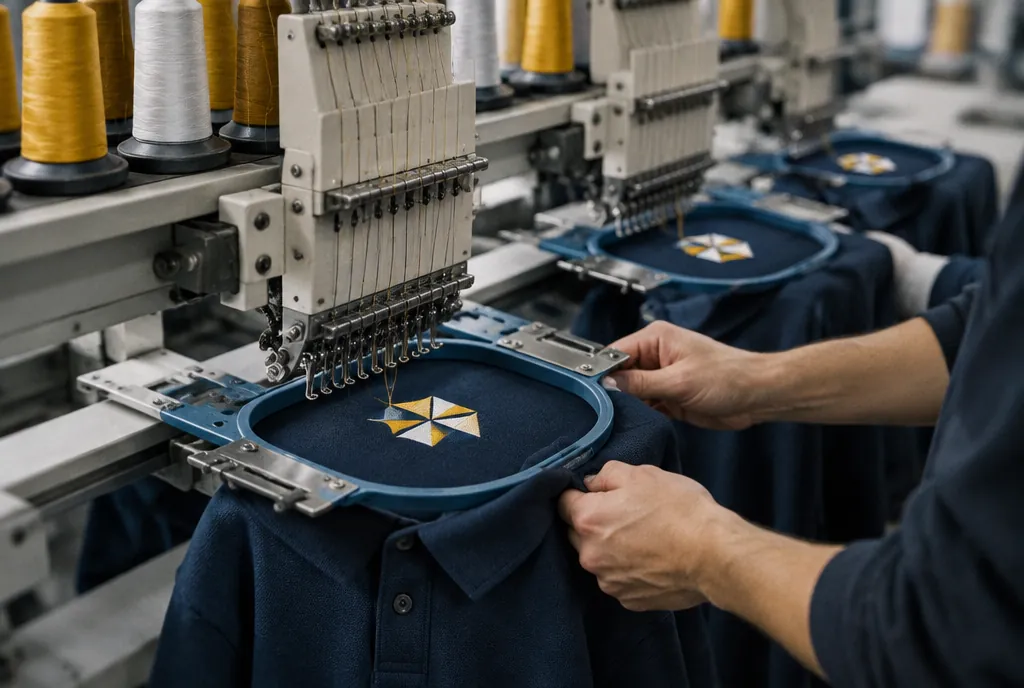
Is $1 per 1,000 stitches still enough?
Often not, because the stitch count leaves out hooping, trims, color changes and folding. $1 per 1,000 stitches is still the most common starting rule you will hear, and it is a fine check, but it is a poor way to set the price on its own.
Take a 5,000-stitch cap logo. At $1 per 1,000 that is $5. If the cap takes 20 minutes on one head, from hooping to bagging, you finish three caps an hour and the stitching earns $15 an hour. That $15 has to pay the rent, the machine payment and you.
Now price the same cap by time. Say your machine hour has to bring in $60. Twenty minutes is a third of an hour, so the stitching is worth $20, four times what the stitch rule gave you. The count did not change. Only the method did.
Some one-head shops set the per-stitch floor higher for this reason, at $2 to $3 per 1,000 when the customer supplies the garment. At that rate, the same 5,000-stitch logo is $10 to $15 a piece.
What should an hour on an embroidery machine earn?
In the example shop it has to bring in at least $53.28 per billable hour just to break even, before any profit. That figure spreads about $31,800 a year of overhead (rent is the biggest line) plus both people's full pay over the hours that actually go on customer orders. How that division works is explained once in how to find your true hourly rate, and the free true hourly rate calculator runs it on your own numbers.
Machine time costs a little more than bench time, because the machine's payments and upkeep have to be carried by the hours it runs. Keep charging for the machine even after it is paid off. The next machine, and the repairs on this one, have to come from somewhere.
The other half of the math is speed. The speed you set on the machine is not what it produces. Thread breaks, trims, color changes and hoop swaps all stop the needle, so real output is well below the dial. The example sheet plans on about 475 stitches a minute of real output, and the best way to find your own number is to time a few full runs, start to finish, and divide.
Heads matter just as much. A 4-head machine finishes four logos in the time a single head finishes one, so each polo on a single head carries about four times the machine time, and the price each has to follow.
Worked example: 24 polos with a 7,000-stitch logo
The sample order prices 24 polos for a plumbing company at $839.22, or $34.97 each. It is a left-chest logo of about 7,000 stitches in 3 colors, mixed sizes, run on a 4-head machine at a real speed of about 475 stitches a minute, with the logo sent out for digitizing.
| A | B | |
|---|---|---|
| 1 | Part of the price | 24 polos |
| 2 | Blanks, thread, backing and bags | $204.00 |
| 3 | Machine and bench time, about 3.6 hours | $203.54 |
| 4 | Digitizing plus the small costs around the order | $149.78 |
| 5 | Markup, cushion and profit | $281.90 |
| 6 | Price | $839.22, or $34.97 each |
The blank is most of the materials line. The time line covers setup and thread colors once, then hooping, stitching, trimming, folding and bagging for every polo.
The shop keeps $281.90 after both wages and the overhead are paid. Spread over every hour the order takes, including the mock-up, sorting and the email back-and-forth, that is about $110 per labor hour, against the $53.28 break-even. That gap is the reason to take the job.
Take the blank and the digitizing out of the price each and what is left for the stitching lands inside the $2 to $3 per 1,000 range some one-head shops use. The cost-based price and the rule of thumb agree, which is a good sign both are in the right place.
Why 12 polos cost more each than 100
Setup, digitizing and most of the order-level costs are the same whether you run 12 pieces or 100, so the price each falls as the order grows. The same sheet prices four quantities at once:
| A | B | |
|---|---|---|
| 1 | Quantity | Price each |
| 2 | 12 polos | $44.85 |
| 3 | 24 polos | $34.97 |
| 4 | 48 polos | $30.03 |
| 5 | 100 polos | $27.46 |
Many shops publish three or four tiers, a premium for small runs, a middle price, and a bulk price. Check the steps between them. If 22 polos cost more in total than 24, a customer will simply order 24, and your tiers are too steep. The sheet avoids this because each quantity is priced from its own cost, not from a jump in a table.
Per stitch, per hour, per piece: which way to quote
Owners quote embroidery three ways, and all three can work if the number underneath is right.
| A | B | C | |
|---|---|---|---|
| 1 | Method | How it works | Where it goes wrong |
| 2 | Per 1,000 stitches | Stitch count times a rate | Ignores hooping, trims and folding |
| 3 | Per hour | Minutes per piece times a shop rate | Needs real timed minutes, not the dial speed |
| 4 | Per piece | A set price for a left chest, a cap front, a back | Fine once built from cost, risky if copied |
The customer usually wants a price each, so that is what the sheet shows at the end. Underneath, it builds that price from the hour, then lets you compare it with the stitch rule. Mid-size designs of roughly 5,000 to 9,000 stitches tend to be the sweet spot for small shops, big enough to be worth the setup and small enough to run fast.
A useful sanity check is profit per hour. If a polo takes 12 minutes, you finish 5 an hour. Wanting $50 an hour of profit means about $10 a polo on top of the blank and your costs. Run that sum on any price before you send it.
Should you double the blank if you already charge for your time?
Not if your time is already priced at a full shop rate, or you count the margin twice. Many shops mark blanks up 100%, and some go to 2 or 3 times cost on caps. In those setups the markup on the blank is also paying for the stitching, and that is fine as long as you know it.
The example sheet charges labor at $53.28 an hour, so it uses a smaller markup on blanks and a separate profit line. Some owners talk about a 50% gross margin target; gross margin is measured before your time and rent, while the example's 34% is what is left after them. The two numbers are not the same thing. The difference between the two ways of adding profit is in markup vs margin.
Digitizing, trims and the spare polo: what embroidery quotes leave out
In the sample polo order the small costs around the stitching add about a fifth to what the order costs to make. Each is small, which is why they go missing.
Digitizing. Turning the logo into a stitch file. Outsourced files for a simple logo often cost somewhere in the tens of dollars, and large jacket backs can run into the hundreds. Put it on its own line on the invoice, mark it up, charge it once per logo and keep the file, so the reorder skips it.
Custom fonts and artwork. A font the customer asks for is the customer's cost, whether it is a few dollars or close to a hundred. Cleaning up a blurry logo is design time and should be billed by the hour.
The mock-up and sign-off. Have the customer approve the proof by email, so a typo they approved is theirs. It is real time before a single stitch.
The sew-out and the spare. A new design gets a test run on scrap before the customer's blanks. Plan for waste too: the quote carries one extra blank for the piece the machine chews.
Trims, color changes and snapped threads. Machine time the stitch count does not show. Two logos with the same count can run very differently if one has many trims.
Freight, sorting and email. The wholesaler's freight bill arrives after the quote went out. A mixed-size order of 24 is really six small counts. The back-and-forth over sizes and colors is the biggest time item in the sample order. Changes after sign-off get their own price (see change orders).
Card fees. The processor's cut comes off the profit, not the cost. The sample quote has it marked "No", which is exactly the kind of gap a checklist catches.
When the customer brings their own coats
Charge more per piece and put the risk in writing, because you earn nothing on the garment and cannot replace it. If the machine ruins a coat the customer found on clearance, there may be no way to get another one.
Selling the garment is where a lot of the profit sits. Run the math: 10 logos an hour at $6 each is $60 an hour. Sell the polo too, with a markup on the blank, and the same hour earns far more, because you are paid for both the stitching and the shirt. That is why the higher per-stitch rates are used for customer-supplied garments, and why the example shop's terms put customer-supplied garments at the customer's risk.
Screen printing and DTF: colors and locations drive the price
Screen print and transfer orders use the same cost-plus method, but setup per color and per print location matters more than the tee count. Every color needs its own screen and every location is its own setup, while an automatic press can print hundreds of tees an hour once it is running. So a one-color, one-location job of 48 tees is cheap per shirt, and a four-color front and back job of 12 is not.
Here is a simple way to build a tee price. Add the blank and the transfer or ink, add your labor minutes at your shop rate, add your share of overhead, then add profit. If a blank plus transfer costs $9 and the labor at your rate is $5, the tee costs $14 before overhead and profit. Price it at $14 and you have done the work for free.
DTF gang sheets bought from a supplier go in as outside work with their own markup, and a heat press run is priced by the minutes per press like any other machine.
Six ways one-head shops underprice a logo order
- Charging only for the blank plus the stitchingSetup, digitizing, sorting and email time all go missing.
- Quoting $1 per 1,000 without timing the pieceHooping, trims and folding are not in the count.
- Eating digitizing and fontsPut them on their own line.
- Matching a multi-head shop's price on one headA shop with six heads runs six logos while you run one. Hold your price, tell the customer why, and compete on service and turnaround instead.
- Ordering blanks before you are paidTake payment in full, or at least 50%, before anything is ordered.
- Using the speed dial as outputPlan on the stitches a minute you really get, timed over a whole run.
Price the next polo order in the sheet
The Embroidery & Screen Printing Pricing Calculator works out your shop rate, prices the order from blanks, minutes and digitizing, asks about every small cost above, and shows four quantities at once, in Excel or Google Sheets. For the theory behind the profit line see overhead and profit, and compare quotes with what really happened using job costing.