
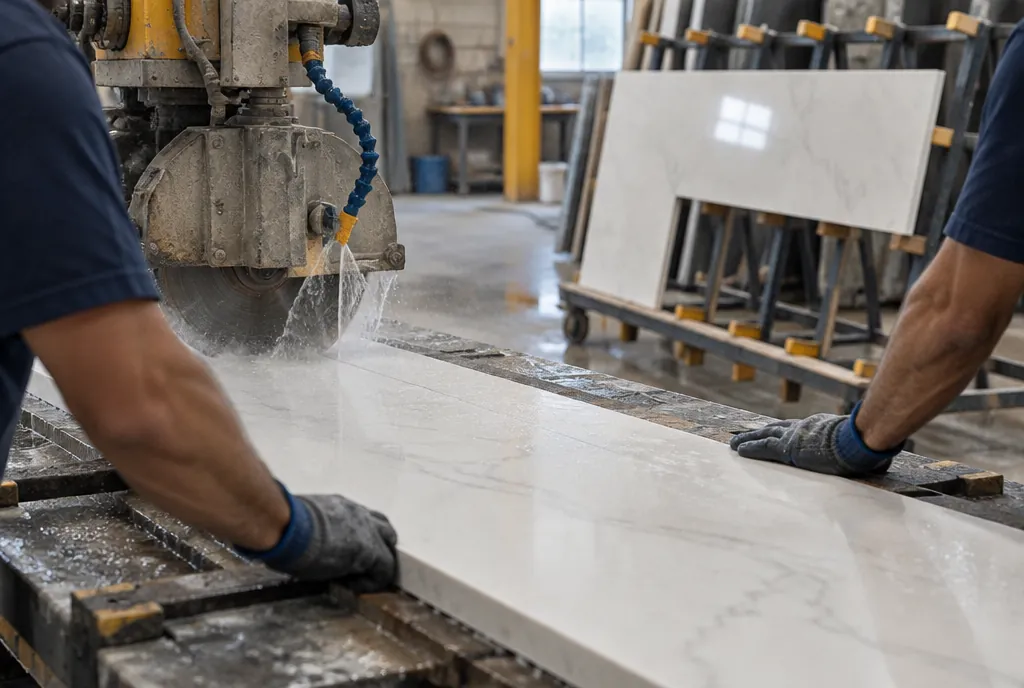
Why countertops sell by the square foot but cost by the slab
Customers compare countertops per square foot, but your cost comes from the whole slab you buy plus the hours on the saw, so price the job first and check the per-foot number after.
The square footage itself is simple. Standard runs are measured at 25.5 inches deep, a 24-inch cabinet plus a 1.5-inch overhang, and 50 sq ft is a common size for a kitchen with an island. A 40 by 55 inch island works out to about 15.27 sq ft (40 x 55 = 2,200 square inches, divided by 144).
The slab is where the per-foot math breaks. Even a jumbo quartz slab is only about 136 by 78 inches, so an island bigger than that either gets a seam or eats most of a slab. The offcuts from nesting are a real cost on every job, which is why the sample prices the slab bought, not the square feet installed.
What a 50 sq ft quartz kitchen came to
The sample L-shaped quartz kitchen with an island prices at $4,668, or $93.36 per sq ft installed, and keeps $1,264 above every cost.
The job is 3cm quartz, about 50 sq ft, with an eased edge, one undermount sink cutout, three faucet holes and a 4-inch splash. The old laminate top comes off first.
| A | B | |
|---|---|---|
| 1 | 50 sq ft quartz kitchen | Amount |
| 2 | Slab, supplies, shop time, install and tear-out | $2,957 |
| 3 | Small forgotten costs on the Quote tab | $447 |
| 4 | Markup, safety cushion and profit | $1,264 |
| 5 | Price, installed | $4,668 |
Full cost is $3,404, or $68.08 per sq ft. The work takes about 19 hours from template to the last invoice, so the kitchen brings in about $137 per labour hour against a break-even of $63.08.
The raw material is only about half the story, and the sample shows it: the slab and supplies, with their markup, are about 45% of the price. The rest is shop time, install, the small costs and profit. If the customer pays by card, the file shows $4,808, because it adds a 3% card fee.
What does a stone shop hour cost before the saw even runs?
In the sample shop, each billable hour must bring in $63.08 just to cover wages and overhead, before any machine time is added.
The shop is an owner and three staff, with about $93,500 a year of overhead. Rent on the shop and slab yard is the biggest piece, and it carries costs most trades never see: silica air monitoring and respirators, slurry disposal and water recycling. The owner's slab-yard walks with customers and blade changes are paid hours that no kitchen is billed for, which pushes the rate up.
People cost more than their wage. Payroll taxes, workers' comp and paid time off can add about 30% on top, so a fabricator paid $25 an hour really costs you around $32.50. On top of that, not every paid hour is billable: breaks, cleanup and blade changes eat time, and some shop owners add 25% to their hours to cover it. Stone work is not cheap to insure for workers' comp, so get your real rate from your carrier. The formula is explained once in the true hourly rate guide, and you can run your own shop through the free true hourly rate calculator.
Bridge saw, CNC and templater: charging for machine time
Charge each machine only for the hours a job actually runs on it, on top of the labour rate.
A bridge saw, a CNC router and a laser templater each have a payment, blades or tooling, water and power. The templating machine alone is a five-figure purchase, and the skill to run it is part of what the customer pays for. To get a machine's hourly cost, add what it cost to what it will cost to replace, spread that over the years you will keep it, and divide by the hours it will really run each year.
In the sample, the template runs on the laser, the cut on the bridge saw, the sink cutout on the CNC and the eased edge on a hand polisher. A kitchen that needs a waterfall or extra cutouts spends longer on the machines, so it carries more machine cost, which is fair.
On margin: the sample keeps 27.1% of the price, and getting there takes a markup of about 37% on full cost. Some shop owners aim for a 20 to 30% margin on everything they make, and the sample sits just inside that. Why a markup is always bigger than the margin it produces is in markup vs margin.
Installed prices per square foot the videos mention
The installed prices in the videos range from $8 a square foot for builder-grade laminate to $200 for quartzite or marble, and none of them comes from a stone shop's own price sheet.
| A | B | C | |
|---|---|---|---|
| 1 | Material | Installed, per sq ft | Who gave the range |
| 2 | Granite | $40 to $100 | A real estate broker |
| 3 | Quartz or quartzite | $50 to $200 | An installer |
| 4 | Marble | $50 to $150; $75 to $200 | The broker; the installer |
| 5 | Concrete | $65 to $135 | The installer |
| 6 | Builder-grade laminate | $8 to $20 | The installer |
The broker also gives quartzite at $60 to $200 and butcher block at $30 to $80; the installer gives butcher block at $20 to $60 and tile at $10 to $30. The broker works in the San Francisco Bay Area, where countertops are said to cost one and a half to two times more than the same option in other major North American cities, so read his ranges as high-market numbers. The sample's $93.36 sits inside the quartz range. Your market decides where in a range you can sell; your costs decide whether that price makes money.
Why a 30 sq ft job costs more per foot than a 120 sq ft kitchen
Small countertop jobs cost more per foot because the template trip, the sink cutout and the install setup take the same time on 30 sq ft as on 120.
The file prices the same quartz, edge and sink at four sizes with the same rules:
| A | B | C | |
|---|---|---|---|
| 1 | Job size | Price | Per sq ft |
| 2 | 30 sq ft | $3,285 | $109.49 |
| 3 | 50 sq ft (the sample) | $4,668 | $93.36 |
| 4 | 80 sq ft | $6,743 | $84.29 |
| 5 | 120 sq ft | $9,509 | $79.24 |
A single vanity sits below even the 30 sq ft line, so a minimum charge takes over there. Quoting a vanity at your kitchen per-foot price is how small jobs lose money. Laminate and butcher block usually come in set lengths and get cut and fit on site, so those tops follow a different pattern from slab work.
Seams, silica and slab-yard visits: what stone shops leave off the quote
On the sample kitchen, the small forgotten items add about 13% to cost, and leaving them all out would cut the price by about 12%, money that comes straight out of profit.
Each one is a line on the Quote tab that needs a Yes, a No or N/A:
-
Layout drawing and slab nesting. Placing the pieces, lining up veining and getting sign-off before cutting. Good shops send a layout drawing for approval first, and that drawing is an hour of paid desk time.
-
The slab-yard visit. A real natural stone slab can look completely different from the small showroom sample, which is why customers want to see it before it is cut. That walk is paid time.
-
The template trip, and the wasted one. Nobody can template until the cabinets are set and level. If you drive out and they are not, that trip is lost unless your terms charge for it.
-
Seam work. Color-matched epoxy in the gap, then a hydraulic seam setter to pull the slabs flush, then cleanup before it hardens.
-
Silica control. Wet cutting, respirators and slurry on every job. Engineered quartz can be over 90% quartz, so the dust is a real health risk, and skipping safety rules such as air monitoring is how shops get into trouble with OSHA. The yearly program sits in overhead; the per-job consumables go on the quote.
-
Field modifications. A backsplash or a run that needs trimming on install day to fit a wall that is out of square.
-
Callbacks and a cracked piece. A seam or chip touch-up after the job is paid, and a piece that cracks on the saw or in the truck. A small reserve on every quote pays for the kitchen where it happens.
-
Tear-out, plumbing and sealing. List them with a markup or exclude them in writing. Sealing applies to natural stone only.
Slab-first quotes, sketch quotes and cheap seams
The costliest countertop quoting mistakes are pricing from the slab alone, pricing off a sketch, and cutting install corners that come back as a redo.
Pricing from the slab. The slab is the visible part; the shop time is where the money goes. Every intricate cut, special edge and sink or appliance cutout adds labour, and mitered and waterfall edges add even more, so time your next few before you guess them.
Pricing off a sketch. Fabricators recalculate the numbers once the template is measured, because a homeowner's sketch is rarely right to the inch. Some shop owners refuse to give ballpark numbers at all, because the first number sticks. Put in writing that the final price follows the template. The difference between the two kinds of number is in quote vs estimate.
Cheap seams that come back. A rushed install leaves wide, uneven seams smeared with extra glue. Saving an hour on seam work can cost thousands if a whole section has to be redone, and that redo lands on the shop.
Not tracking hours. Track the time every kitchen takes so the next price is better. A kitchen that runs well over its hours can turn an expected profit into a loss, and job costing is how you catch it before the next quote.
Granite, quartzite and marble: what changes in the estimate
Switching from quartz to natural stone changes the slab line and adds sealing, but the method and the shop rate stay the same.
Granite needs sealing when it's installed and every one to two years after, so sealing becomes a labour line on granite, quartzite and marble jobs. Quartz has its own weak spots: it can scratch, scorch and yellow in direct sunlight, and a hot pan can crack a piece. A written term that heat and UV damage are not covered protects the shop on quartz.
Anything the customer changes after the layout is approved, such as moving a seam or adding a cooktop cutout, belongs in a written change order. How the $93,500 of yearly overhead lands on each square foot is covered in overhead and profit.
The Countertop Fabrication Pricing Calculator does every step above in Excel or Google Sheets, from your break-even and machine rates to the forgotten-cost lines and a customer quote with countertop terms. Its Job Log then shows whether each kitchen made money.