
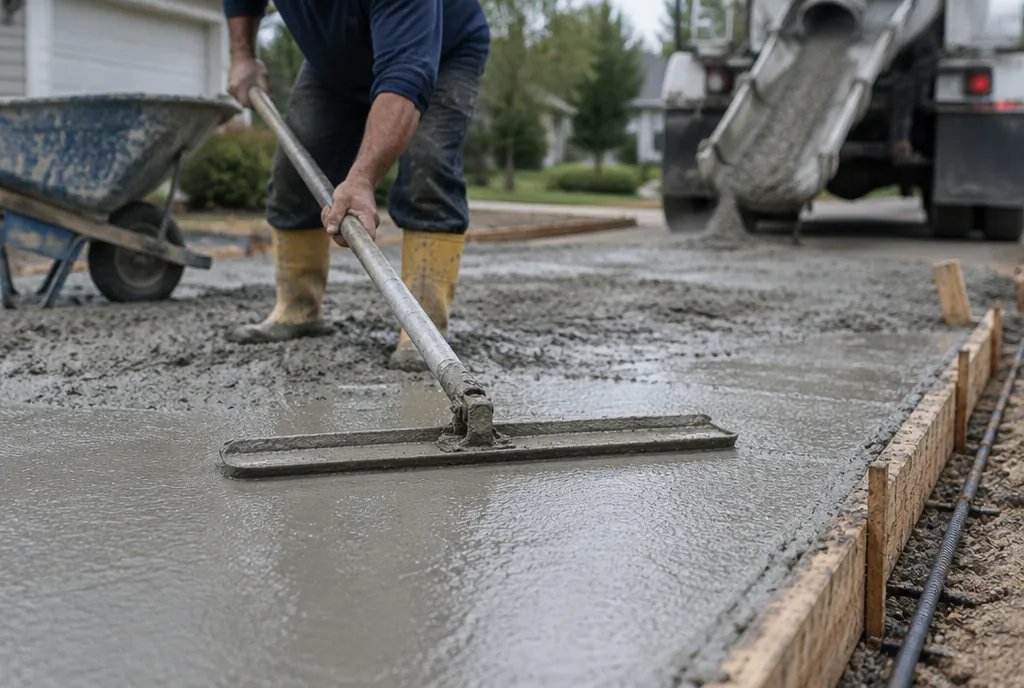
Why flatwork gets priced by the job, not the square foot
A square-foot price can't see tear-out, base, access or thickness, and those decide what a pour costs. Customers still ask for one, often by email before anyone has looked at the site.
The honest answer is that walkways alone can run from single digits to several times that per square foot, depending on what is under them, how far the concrete has to travel and how much finish work they need. A 75 ft walkway on flat, open ground and the same walkway behind a house with an old slab to break out are two different jobs.
So price the job from its own numbers first. Ask for photos or visit, work out the yards, tons and crew hours, and only then divide by the square feet to see if the result looks sane next to your other work.
Yards, tons and sticks: what a pour costs before labour
Materials on flatwork are the delivered concrete plus everything under and around it. For a 4 inch slab, square feet divided by 81 gives cubic yards, so the 960 sq ft driveway needs 11.85 yards and 12 get ordered.
Price the yard as it lands on your invoice, not the plant's posted price. Plants add environmental fees, washout fees, fuel surcharges and tax on top of the base price per yard, and on a small order those can add more than 10% to every yard. Put the all-in delivered figure on your Price List.
Then add rebar by the stick, gravel base by the ton, dump fees on what you tear out, forms and cure. Dump fees are the one people underestimate: a driveway's worth of old asphalt or concrete is many tons, and every ton is charged at the transfer station.
What a crew hour on a slab has to earn
In the worked example, each billable crew hour has to bring in $57.83 to cover wages, payroll costs and about $45,400 a year of overhead. The company is an owner-finisher and two crew, and the biggest overhead lines are yard rent, insurance and marketing.
The same math gets bigger fast on a larger company. A crew wage of $28 an hour costs about $33.60 once you add 20% for payroll taxes and workers' comp. Add the company's overhead spread across every crew hour and the real cost of an hour can land near $80, before any profit.
Season length matters as much as wages. A flatwork crew in a cold state may only pour about 40 weeks a year, so a full year of truck payments, insurance and rent has to ride on fewer hours. The general method is in the true hourly rate guide, and the free true hourly rate calculator does it with your numbers.
The 960 sq ft driveway, start to finish
The worked job tears out an old asphalt driveway, lays a compacted gravel base, and pours a new 24 x 40 ft, 4 inch broom-finish driveway in 4000 psi exterior concrete over a #3 rebar grid, with saw-cut control joints. No pump: the ready-mix truck can back up to the forms.
The crew time is set out stage by stage, from layout and tear-out through base, forms and steel, the pour and finish, saw-cutting, and stripping forms. It comes to about 66 labour hours once the hidden hours are counted, plus running time on the skid steer, plate compactor, saw, dump trailer and crew truck.
| A | B | |
|---|---|---|
| 1 | 960 sq ft driveway | Amount |
| 2 | Materials, labour, equipment and permit | $7,947 |
| 3 | Hidden costs (buried concrete, fuel, extra yard and more) | $930 |
| 4 | Markup, cushion and profit | $2,905 |
| 5 | Price | $11,782 |
Cost is about $9.25 a square foot and the price $12.27. The $2,905 above cost is 24.7% of the price, kept after the owner's own wage, and the job pays about $101.84 per labour hour against the $57.83 break-even. If a driveway quote comes out close to break-even per hour, you would be pouring for wages.
When you are new to estimating, lean long on the hours. A job that takes a day longer than you priced costs you a full crew day, while an hour or two of padding costs the customer very little. Once your Job Log has a season of real hours in it, you can tighten the estimate.
What concrete owners charge per square foot, and why it varies
Prices for flatwork in the research ran from under $4 a square foot for a pour-only floor to over $15 for a hard job with removal. These are single examples, not averages, and each one depends on what the job included.
| A | B | C | |
|---|---|---|---|
| 1 | The job | What it included | Price |
| 2 | House and garage floor, 2,524 sq ft | Pour and finish only, no prep, older prices | about $3.77/sq ft |
| 3 | Patio, 396 sq ft | Excavation, base, forms, 30% on cost | about $12.37/sq ft |
| 4 | Patios, walks and driveway, 1,426 sq ft | Removal, rated easy to hard | $11 to $15.67/sq ft |
| 5 | Worked example, 960 sq ft driveway | Asphalt tear-out and base | $12.27/sq ft |
The spread inside the 1,426 sq ft job is the useful part. The materials stayed the same; only the hours changed with how hard the site was. That is why a copied square-foot price can be right on one job and badly wrong on the next.
Profit targets vary with the size of the shop. Some lean flatwork owners aim for 30 to 40% on cost on small jobs, and a bigger company might net nearer 20% on a single bid and less across a whole year. 30% on cost is about a 23% margin, a gap explained in markup vs margin.
Buried slabs, short loads and pump trucks: what flatwork quotes miss
On the worked driveway the easy-to-miss items added about $930 to cost; leave them out and the same rules price the job near $10,610 instead of $11,782. Each is small, which is why they slip.
Test holes and buried concrete. A patch that looks like wood chips or sod can hide an old slab. Take a shovel to it at the site visit, because buried concrete means more tons, another dump trip, more fuel and more hours that nobody priced.
Fuel. Pit runs, picking up forms and steel, and the skid steer all burn it. Put a round fuel figure on each estimate until your own records show the real average.
The extra yard. Grade is never exactly 4 inches. On a big pour it is cheaper to order a yard extra and send some back than to run short and see a cold line where one truck met the next.
The short-load fee. Plants charge extra when a small job orders under their minimum load, and on a walkway that fee can eat most of the profit.
Pump truck or power buggy. If the truck can't reach the forms, a pump or a buggy is a real line on the quote, and the pump needs concrete of its own to prime it.
Splatter cover and next-day cleanup. Plastic against the house and a crew back the next day to strip forms and clean up are time and material. Owners who promise that cleanup win work with it, so price it in.
Supply runs, drive time, blade wear and the seal trip. Picking up steel and poly, the daily drive, the saw blade you wear down on joints and the trip back to seal are all paid time or cash that never touches concrete.
Crack callbacks. No finisher can promise a slab won't crack somewhere other than a joint. Hold a small reserve and put that sentence in your terms; the research gives no dollar figure for it, so set your own.
Why a 6 inch slab can't take the 4 inch price
Most concrete pricing mistakes come from carrying one job's number onto a different job. A 6 inch slab takes 50% more concrete than 4 inches, so bidding it at the same square-foot price leaves your concrete cost far higher than you priced, before the extra finishing time is even counted.
Copying the market rate. Owners who price off competitors per square foot or per linear foot often find out at year end that some jobs paid and some didn't. Pricing crew hours from your own break-even fixes that.
Leaving profit off the sheet. Without a profit line, a job that goes perfectly only covers its costs, which means you did it for free. One bad day turns it into a loss.
Ordering to the exact yard. If the math says 4.88 yards, order 5. On a big floor, add more. Running short costs far more than the spare yard.
Never checking the pour afterwards. Write down the real hours after each job, or next season repeats this season's misses. Tracking that is covered in job costing.
When does a minimum charge beat a square-foot price?
On any pour small enough that setup, driving and truck fees are most of the cost. A small pad still needs the truck, the forms, a crew day and often a short-load fee, so some flatwork owners set a project minimum in the thousands and raise it each year as their costs go up.
Per-yard numbers move the same way. The worked driveway comes to about $740 of cost and $982 of price per yard, but a pour-only floor sheds the tear-out and base and drops far below that. Anything found once the old surface is up, like soft ground needing more base, goes on a written change order. How overhead and profit flow into each foot is in overhead and profit.
Price the next driveway in the spreadsheet
The Concrete & Flatwork Pricing Calculator runs this page in Excel or Google Sheets: your break-even rate, yards and tons from your own Price List, crew hours stage by stage, every easy-to-miss line answered, and a customer quote with flatwork terms. The Job Log then shows which pours made money.