
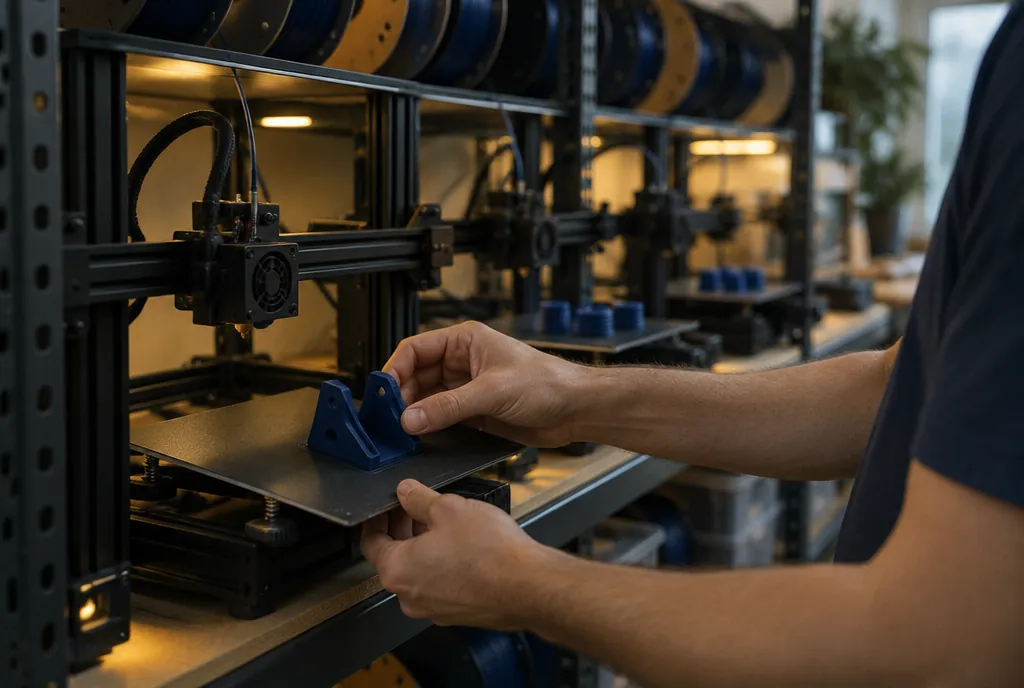
Why the grams are the smallest part of a 3D print's price
On a finished part, the filament is usually the cheapest line, so a price built from grams leaves out most of the cost. Our example jig uses about $2 of PLA and sells at $36.71 in a batch of 25. The other $34 or so is printer time, hardware, the face plate, hands-on work, the extras and profit.
"Landed cost" is a manufacturing term for what it really costs to get one finished part out the door. On the jig that means slicing, loading plates, pulling parts, pressing six heat-set inserts, fitting screws, a face plate, a T-bolt and a knob, and bagging it. None of that shows up in the slicer's gram count, and on a part like this the landed cost is several times the filament.
Per gram and per print hour still work as a check after the price is built. Our example jig works out to about $0.56 a gram, or about $18 per print hour. Neither number would travel to a plain vase with no inserts, or to a print that needs an hour of support removal, which is why the file starts from the part.
Two hourly numbers: your hands-on hour and the printer's print hour
A print shop needs two hourly rates: a big one for every minute a person touches the job and a tiny one for every hour a printer runs. Mixing them up is how sellers end up charging a dollar a print hour and nothing for themselves.
Your hands-on hour. Our example shop, an owner and a part-time helper with $16,780 a year of overhead, needs $44.57 per billable hour to break even. The big reason it is higher than a wage is the unpaid time: product photos, listings, messages, markets and fixing printers. Only about 60% of the owner's hours in the example go on paid orders. How to build your own is in the true hourly rate guide and the free true hourly rate calculator.
Sellers who share their numbers use very different labour rates, from about $10 an hour, which is too low to live on, to $20 to $30. A sensible floor is what you earn per hour at your day job. If the print business pays you less than that, it is costing you money to run it.
The printer's hour. The example fleet is eight printers. Each one's price is spread over the hours it will run before it wears out, then repairs and power are added, which comes to about 15 cents per print hour. Farm owners who track this often plan on roughly 5,000 print hours of life for a CoreXY printer and 3,000 for a bed slinger. A few cents an hour sounds like nothing, but across a farm running around the clock it adds up to real money every week.
Worked example: 25 stop block jigs for a woodworking store
A woodworking store orders 25 miter saw stop block jigs with its logo on the side, bagged for retail, and the file prices the order at $917.69. Each jig has heat-set inserts, a laser-cut aluminum face plate from a local shop, a T-bolt and a knob.
Hands-on work is a little setup once, then about 12 minutes per jig: pulling parts, cleaning strings, pressing inserts and assembly. The face plates come from outside, with a lot fee plus a price each, so they carry their own markup: you carry the risk if a batch comes back wrong. The extras are adding the store's logo in CAD, a test print for approval, a reprint allowance, back-and-forth and invoicing, and the outer box and drop-off.
| A | B | |
|---|---|---|
| 1 | 25 jigs | Amount |
| 2 | Filament, printer time, hardware and face plates | $184.50 |
| 3 | Hands-on labour | $257.06 |
| 4 | Logo work, test print and other extras | $207.01 |
| 5 | Markup, safety cushion and profit | $269.13 |
| 6 | Price for 25 | $917.69 |
That is $36.71 a jig, with half taken as a deposit. The $269.13 above full cost is about 29% of the price, left after the owner has already been paid. The order takes about 9.25 hours of hands-on work in all, and that time earns about $73.75 an hour. At $36.71 wholesale, the store has room to mark the jig up and still sell it at a normal retail price.
One jig for $395.48, 100 for $25.50: why quantity changes the price
The logo CAD work, setup and test print are paid once, so the fewer jigs in the order, the more of that each jig carries. The same file prices four quantities:
| A | B | |
|---|---|---|
| 1 | Jigs ordered | Price each |
| 2 | 1 | $395.48 |
| 3 | 10 | $59.13 |
| 4 | 25 | $36.71 |
| 5 | 100 | $25.50 |
Nobody pays $395 for one jig. That line is the useful warning: a one-off custom logo job is only worth taking with a design fee, or not at all. Farm owners who started spreading setup time across a full batch report production cost dropping by about a quarter.
Sending the customer a quantity table shows them why bigger orders cost less each, and it stops you from pricing a single piece like part of a batch. The price is tied to the quantity and the test print they approve, which is why it is a quote and not an estimate (quote vs estimate).
Failed plates, purge towers and logo work: what slips out of a print quote
Leave the extras off the 25-jig order and the same pricing gives about $635 instead of $917.69, roughly $25 a jig instead of $36.71. These are the costs 3D sellers most often forget.
- Failed prints and reprints. Spaghetti, warping and layer shifts cost filament, printer hours and your time again. A common allowance is 10% extra material, which the example uses.
- Purge towers and support waste. Use the slicer's total-used number, not the part number. On a multi-colour job the purge can outweigh the part.
- Bed cleaning, clogs and troubleshooting. Nobody pays for the hour spent unclogging a nozzle, so it has to be spread across the orders that ran on that printer.
- CAD work on the customer's logo or file. "Just add our logo" sounds like five minutes and rarely is. Changes after the test print is approved go on a written change order.
- The test print for approval. It ties up a printer and your time before the order is confirmed; on a one-off it is most of the price.
- Packaging. Every box, filler, label and thank-you card belongs in the product cost, with the customer paying real postage on top. Cents per item, multiplied by every order.
- Marketplace fees. Etsy takes a listing fee, a payment processing fee and a share of each sale, which is why items under about $10 are hard to sell there at a profit. Check the current rates and put them on every marketplace quote.
- Model licences. Selling prints of models you don't own or haven't licensed is a common and costly mistake. Have customers confirm in writing that they own any logo or file they send.
Filament times three, 50% on top: pricing rules 3D sellers use
Most sellers start with a simple rule, and the rules only hold up on simple prints. The higher prices always go with parts that carry hardware, electronics, assembly or a custom logo, because those parts carry more hands-on time.
Filament times three. Multiply the filament cost by three, sometimes with a small charge per print hour added. On a plain printed figure that takes a few grams and no finishing it can land near a fair price. On the jig it gives about $6 for a part that costs far more than that to make.
Cost plus 50%. Add up filament, power, hardware and packaging, then add half again. Better, because hardware is counted, but if your time is not in the cost, the 50% is really just your wage in disguise.
Match the cheapest listing. Copy the lowest price you can find on Etsy. This is the one to avoid: the other seller may be printing at a loss, or not paying themselves at all.
| A | B | C | |
|---|---|---|---|
| 1 | Rule | What it counts | What it misses |
| 2 | Filament times three | Filament | Hardware, labour, failures, extras |
| 3 | Cost plus 50% | Filament, hardware, packaging | Your time, unless you add it |
| 4 | Cheapest listing | Nothing about your shop | Everything |
| 5 | Whole-part price (this page) | Every cost, then profit | Nothing you answered on the checklist |
The difference between the plain figure and the jig is time, and time is exactly what the simple rules leave out.
What margin should a 3D print shop aim for?
Aim for at least 25% of the price, about 50% if you can, and more on anything a retail store will resell. A store usually wants to buy at around two thirds of the shelf price, so a part that costs $30 to make needs a retail price near $90 to wholesale at $60 and still leave you a margin.
Our example order keeps about 29% of the $917.69 price, and that is after the owner's $44.57 rate is already in cost, so it sits close to net profit. Getting there took a markup of about 41.5% on the $648.56 full cost, because a margin is a share of the price and a markup is added to cost; a 50% margin needs a 100% markup. The full explanation is in markup vs margin and overhead and profit.
Plan one more slice: income tax. One small shop owner sets aside about 30% of what he earns, and suggests checking the right number with an accountant.
Copying Etsy listings and four other 3D print pricing mistakes
The most common mistake is pricing from other sellers' listings instead of your own costs. Plenty of sellers admit they started by guessing and looking at what others charged, then found out months later that some products never made money.
Running too thin a margin. Selling a part that costs $7 for $8 is about a 12% margin, and that is before any of your time is counted. One failed plate wipes it out.
Discounting blind. At 30% off a product may still make a thin profit, while at 50% off the same product can lose money on every sale. Work out the discounted price against your cost before you run the sale.
Selling under $10 on a marketplace. After fees and shipping, cheap items can leave a couple of dollars, and then the question is whether an hour of work was worth it.
Never checking afterwards. Track each order's real hours against the quote so you learn which products pay; that is job costing.
Put your next batch of prints through the Quote tab
The 3D Printing Pricing Calculator turns your overhead and people into a hands-on rate, costs each printer per print hour, asks every extra above on every quote and prices four quantities at once. The Job Log then shows whether the order made money. This page covers FDM printing only, so resin, SLS and metal prices are not given here.